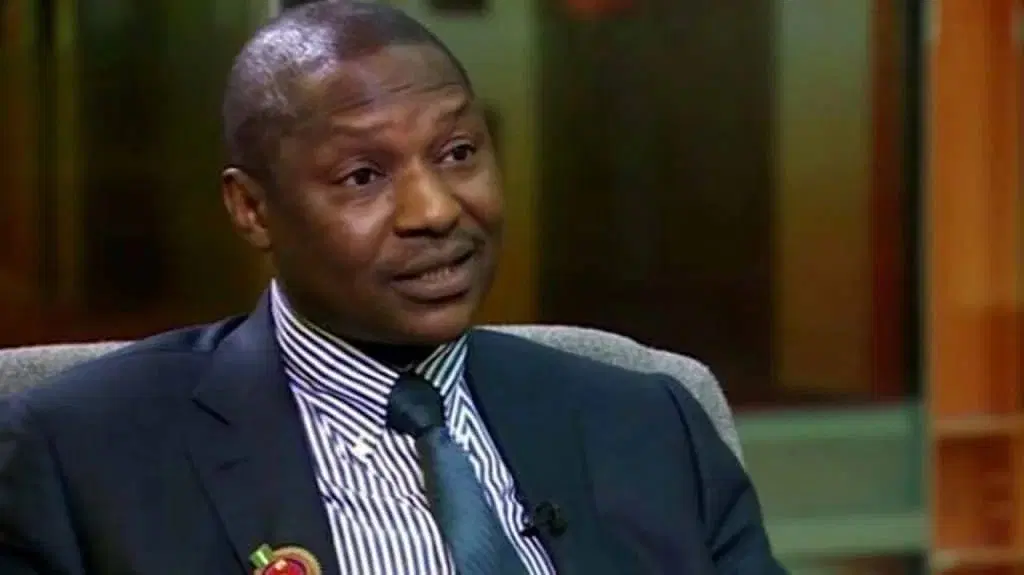
Former Attorney-General of the Federation Abubakar Malami (SAN) has asked a Federal High Court in Abuja to lift an interim forfeiture order placed on three high-value properties out of the 57 assets seized by the Economic and Financial Crimes Commission (EFCC), insisting that the properties were lawfully acquired, properly declared, and in no way connected to proceeds of crime.
Malami, who served as Nigeria’s chief law officer and Minister of Justice from November 2015 to May 29, 2023 under former President Muhammadu Buhari, is currently facing a 16-count charge of money laundering filed by the EFCC.
The charge sheet, which names him alongside his son Abdulaziz Abubakar Malami and one of his wives, Hajia Bashir Asabe, alleges that the trio conspired to launder public funds amounting to approximately N9 billion (some court documents cite N8.7 billion).
Prosecutors claim the defendants concealed and disguised the origin of these funds by investing heavily in choice real estate across several states and the Federal Capital Territory.
On January 6, 2026, Justice Emeka Nwite granted the EFCC an interim forfeiture order over 57 properties said to be traceable to Malami and valued collectively at roughly N213 billion.
The listed assets are located in Abuja, Kano, Kebbi, and Kaduna states. The court directed the anti-graft agency to publish the order in national newspapers within 14 days, inviting anyone with a legitimate interest in the properties to appear and show cause why they should not be permanently forfeited to the Federal Government of Nigeria.
In a detailed counter-affidavit and motion argued by his lead counsel, Chief Joseph Daudu (SAN), Malami is specifically seeking the vacation of the interim order in respect of three properties listed as Nos. 9, 18, and 48 in the EFCC’s schedule:
- Plot 157, Lamido Crescent, Nasarawa GRA, Kano — purchased on July 31, 2019.
- A five-bedroom duplex with boys’ quarters at No. 12 Yalinga Street, off Adetokunbo Ademola Crescent, Wuse II, Abuja — acquired in October 2018 for N150 million.
- ADC Kadi Malami Foundation Building — purchased for N56 million.
Malami told the court that one of the properties (No. 48) is held in trust for the estate of his late father, Kadi Malami Nassarawa, while the remaining two were acquired through legitimate means either before or during his time in office.
Crucially, he stressed that all three properties were fully and accurately disclosed in the asset declaration forms he submitted to the Code of Conduct Bureau (CCB) between 2019 and 2023, in strict compliance with Paragraph 11 of the Fifth Schedule to the 1999 Constitution (as amended).
He argued that these sworn declarations constitute prima facie evidence of lawful acquisition and ownership. According to Malami, the EFCC has failed to place any credible prima facie evidence before the court linking the properties to criminal proceeds. Instead, he accused the commission of obtaining the interim order through:
- Suppression of material facts
- Manifest exaggeration and malicious inflation of asset values
- Deliberately incompetent and manipulated valuations designed to mislead the court
Malami further outlined the lawful sources of his wealth as previously declared to the CCB. These include:
- N374,630,900 from salaries, estacodes, severance allowances, and other official entitlements earned during his eight-year tenure.
- N574,073,000 realised from the disposal of assets over the years.
- N10,017,382,684 in business turnover generated from various legitimate enterprises.
- N2,522,000,000 extended as loans to businesses.
- N958,000,000 received as traditional gifts from personal friends and associates.
- N509,880,000 generated from the public launch and presentation of his book titled Contemporary Issues on Nigerian Law and Practice: Thorny Terrains in Traversing the Nigerian Justice Sector – My Travails and Triumphs.
He maintained that these documented income streams, together with continuing profits from his businesses, more than adequately account for the acquisition of the properties in dispute and demonstrate that they were purchased through legitimate means.
In his prayers, Malami is asking the court for two principal reliefs:
- An order vacating, setting aside, or discharging the interim forfeiture order of January 6, 2026 in respect of the three properties.
- An order restraining the EFCC, its agents, or proxies from interfering with his ownership, possession, use, or control of the properties while the matter remains pending.
He described the EFCC’s action as an unwarranted assault on his constitutional right to own property, his presumption of innocence, and his right to enjoy family life without disturbance. Malami urged the court to dismiss or strike out the forfeiture proceedings to prevent conflicting judicial outcomes and duplicative litigation.
The case is one of several high-profile actions the EFCC has taken against former public officials since the change of administration in 2023. The matter remains pending before Justice Emeka Nwite, with further hearings expected as parties respond to the court’s publication directive and address compliance issues raised in earlier sittings.
The development continues to draw public attention, given Malami’s long and influential tenure as the nation’s top legal officer during the Buhari years.